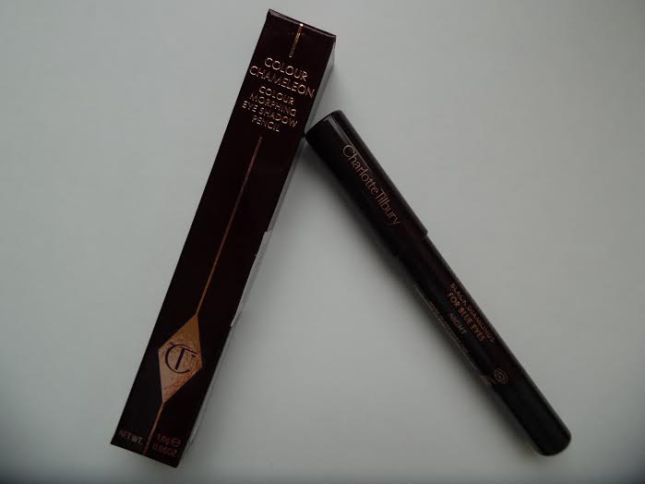
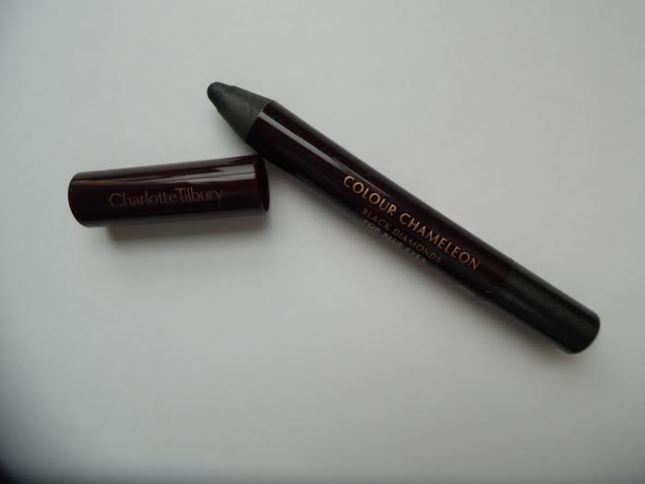
Charlotte Tilbury Color Chameleon Color Morphing Eyeshadow Pencil in “Black Diamonds”

It’s so hard to find things on beauty blogs that work for everybody, regardless of race, but eyeliner in black is pretty much one of the few things that is across the board. This seems like a pretty cool one to add a little razzle dazzle to your day!

krissy00417's avatarDaily Musings | Adventures in Life & Beauty Products

As promised, more Charlotte Tilbury reviews are here! In today’s post, the Charlotte Tilbury Color Chameleon Color Morphing Eyeshadow Pencil in “Black Diamonds” will be the star of the show and it’s truly a product that has impressed me. While the reviews I’ve read about this is about average, I find that it’s a really easy product to use — so, for me, it’s great for travel or when I’m in a hurry.

CL

CL2

Charlotte Tilbury Color Chameleon Color Morphing Eyeshadow Pencil is a product that is designed to “bring out the natural sparkle of your eyes.” The pencil is not self-sharpening, so you’ll have to have a separate sharpener on-hand for this product. However, the formula is superb so it’s something I can personally overlook. This eyeshadow pencil “is infused with synthetic sapphire, a mineral gemstone with natural soft-focus powers for a smooth, perfect finish.” It’s packed with tons of…

View original post 290 more words

How I Afford to Travel… And You May Not Like What I’m Going To Say

Traveling and immersing yourself in a culture, not just doing the touristy things for a week, is a great way to build empathy and humanize people and cultures that have previously seemed foreign, or like they’re just in a textbook, or exotic. So many people have started to find ways to travel on a budget. I think that what Kate talks about below is an excellent way to travel, but to be honest, it sort of reeks of privilege. Obviously not too much economic privilege, that’s the point. Maybe not even White privilege, although a bit of that. But the idea that it’s ok to just hop into another country for a year, steal a job (because really, that’s what you’re doing. Isn’t that what so many people say “others” are doing to jobs in America?–both those here legally with work visas and those here illegally but often doing jobs most Americans aren’t clamoring for anyway), and make sure you save as much as humanly possible, which means not putting too much of that income you’re drawing from an economy back into it, and you’re taking up some low-income housing and possibly other benefits for a year… I think this is a good framework to start from, and traveling and trying to immerse yourself in another culture is a wonderful thing, but you’ve really got to include thoughts of the impact you’ll have wherever you’re traveling as well.

So in summary, I say take Kate’s post a guide, but consider the effects your living will have on other people whose LIFE is in the country you’re visiting. Invest in small businesses, local artisans, and rent in places that don’t take housing from low-income locals. The first two also make for excellent souvenirs for your friends and family back home, and help your story, especially when you come back stateside and have all these experiences for your resume and job hunt. They also help you truly experience what “local” culture is, not just of the whole country, but of the towns you’re living in and visiting. Make it authentic. Live life, not just travel and save.

Also, use this trick for cheaper flights, since you’re going abroad!

Kate's avatarKate from the States

The honest truth – I never have the money I need to travel, but I buy the ticket anyway. I’ve realized that money comes and goes, but the more I make, the harder it is to part with it and weirdly, the less I have, the easier it becomes to budget.

I don’t do that saving account, checking account, travel account thing either. I am not rational. I am extreme. I want to travel and so I do. There is no in between. While I was working my first career job in public relations, I realized early on that it was going to take me forever to save all the money I would need to see the world. I come from a middle class family, I’m the middle child of five and I live in one of the most expensive places in America – Long Island, New York. I don’t…

View original post 1,710 more words

Going to the Water: Cherokee Perspectives on Cherokee Culture

Language is so important. The language we choose to express ourselves in, the individual words we choose, and keeping traditional languages alive and living, moving with the cultures they are a part of. Part of why multilingual people are generally smart is because they’re using more of their brains. Another reason is that they’re more likely to be slightly more open-minded, because there are entire CONCEPTS, not just words, that exist in one language and don’t in another. Language encapsulates culture, heritage, ethnicity, and life.

Send who back to where? When will you send yourself?

White supremacists have always been a group that, at least from a distance, I find really interesting. The thought process that has to go into genuinely segregating oneself so much that they cannot see the humanity in another person, or just don’t care to know it, and often still identify very strongly with Christian or other religious values (do they not know that Abrahamic religions originated in the Middle East, with people who were brown?)… how does one even arrive at that while doing more than just spewing talking points? I’ll let you all read the article for yourselves with the link below, but first, a commentary on one specific part.

“I do believe in ethnic cleansing,” says Hallimore, whose group has an estimated 50,000 followers, a large share of whom identify with the Aryan Brotherhood, the white-supremacist prison-gang and crime syndicate. “I would cleanse the U.S. and send [the African-Americans] back to Africa, but I’d do it in a kind way by providing for them and getting them started back toward their homeland. The same for the Orientals and the Mexicans and so on.”

Why do American white supremacists always say this? At least for British ones, it sort of makes sense. But if you’re in America, and you’re going to send everyone back to “their homeland,” don’t you know that you need to send yourself back, too? That most “African-Americans” have 1) European ancestry as well 2) roots in this country probably farther back than your family? That some African immigrants to America didn’t come on slave ships and were, in fact, free, and did, in fact, own slaves as well? That some African-American might actually be your ancestor, too, if you look hard enough into your history? And more likely, that you are (at least distantly) related to someone African-American by blood? Do they know that the “Orientals” have been here since they were ad bactually called Orientals? That Asian-descendant Americans built our railroads and were an integral part of expanding our great nation out westward? Do they know that the Mexicans were here first, especially in places in the western half of the United States, and that this IS their homeland? Do these people genuinely not realize that THEIR homeland is, well, EUROPE, not the good ‘ol U.S. of A.? That if we were really going to ethnically cleanse America and send all of the immigrants back home, no one would be left except BROWN people? Well, actually, that’s not entirely true. In part because genocide–which, by the way, these guys need to find a dictionary and see the real definition of, because it’s definitely death to a people or culture by 1) actual death or 2) deliberate intermarriage/forced adoption with the intent of erasing and eradicating culture and eventually, distinguishing characteristics–has been perpetrated against, say, Native American tribes, with the second definition applying so broadly that many people who are phenotypically identified in America as White, Black, or Hispanic/Latino are, in fact, at least part Native American. So… logic? We already know that these thoughts aren’t particularly logical, but at least they seem to have some sort of logical flow to them. Do they know history? Do they understand how the U.S. was founded and what peoples immigrated here when and played what role in building the infrastructure? Do they understand that White people are ALL immigrants in some way or another? That African-descendant and Asian-descendant Americans were here at the nation’s inception and before, as well? Someone should teach them. Will it be me? Help me do it here. Then scroll down just a little bit more … here you go… to View the original post.

Changing the School Discipline Structure

Have you heard about the racial disparity in punishments faced by students in public school systems nationwide? According to Dr. Bernadeia Johnson, superintendent of schools for the Minneapolis public school district,

In Minneapolis, a low-income black student is six times more likely than a white student to be suspended for at least one day in a school year.

Well, that must be just a Minneapolis, or maybe a Minnesota problem, right? It can’t be nationwide. But it is. Across the country, students of color are routinely given harsher sentences, ranging from detention all the way up to jail time, for infractions that White students are often sent, instead, for psychological help or mediation. We’re talking about a range of offenses, from fights and property damage to the wrong hairstyle or dress code violations. We’re comparing apples to apples–student punishment for dress code violations to dress code violations and fights to fights. While Minneapolis has one of the highest disparities nationwide, this is a problem that occurs in every district. Do White students get suspended or expelled, too? Sure. But being six times more likely just because of the color of your skin? Unfortunately, it’s been proven. It’s usually not a conscious choice by the teacher or other disciplinarian. Our racial bias in this nation runs deep, and is often below the level of consciousness. Dr. Johnson explains,

Despite an educator’s best intentions, a discipline decision may be unintentionally biased.

This courageous woman intends to right the system. She’s implementing a whole new set of rules, including a review of each suspension of a student of color, to fix the problem. Some critics have been concerned, however, that this new system will disadvantage White students. She addresses those concerns in the Washington Post.

Our new discipline policies do not put white students at a disadvantage simply by addressing unfair discipline for students of color. Focusing our efforts on improving the school experience for students whom our system has failed does not require us to neglect students for whom the system is succeeding. If we are to improve our nation’s future, we must change the academic trajectory for black and brown students. … As an educator who fervently believes in the potential of every child, I cannot perpetuate this deep, damaging inequity. For generations, we have failed our students of color. We cannot afford to let another generation fall short.

I agree with her; we cannot afford to let another generation fall short. Please View the Original Post, and don’t forget that student interest in their learning material can make a dramatic difference in behavior. Help HypheNation achieve that goal by supporting our textbook line creation.

Trust Me, I Don’t Have Privilege.

Over the past … well, life, but particularly rising in number this past week, we’ve all had these conversations. Conversations where, if you’re White, you’re talking to your friends of color and saying “I don’t have privilege, though. I’m [Jewish, Russian, handicapped, poor, uneducated, insert other reason here].” And they’re most likely a bit frustrated, as are you at being made to feel guilty about something you don’t feel like you should feel guilty about. And you shouldn’t, guilt is NOT the emotion we’re going for evoking, here. Understanding and empathy, more like. If you’re not White or Black, you get intersectionality somewhat already, but this article may help solidify some things. If you’re Black, you’re probably going nuts over these conversations, because you have some concept of intersectionality, even if you don’t have the language. You know that maybe it sucked for your friend to grow up with only peanut butter and jelly sandwiches for lunch and dinner every day, while you had gourmet dinners in your family’s mansion, but that’s a different kind of privilege than what you’re having THIS conversation about–and it’s an important conversation, too, and should happen, but it doesn’t mean that when they walk into a store in their ratty hand-me-downs, they’re going to be followed or assumed to have stolen something the same way that you, walking in in your brand new $500 outfit will. Class privilege is a thing. Health and ability privileges are a thing. Citizenship privilege is a thing. Those are all conversations that America needs to have. But right now, we’re having this one. Here’s race privilege. Click the link below to read more.

Explaining White Privilege to a broke White Person

Only Empathy Can Solve This. Can You Find Yours?

This civil rights lawyer sort of put my thoughts into words way better than I could’ve. It’s really true. Maybe some people are getting facts wrong. Maybe some people are saying facts don’t matter. But the point is this; sometimes facts and labels make for great talking points. They make for great ways for people to express their side of the story. They make for great ways to force people to acknowledge the problem, or hide behind their points of view. But on the ground, in the day-to-day, the facts don’t always matter. The emotions matter most when it comes to automatic reactions. Those have to be addressed, in a non-factual but actual basis. This is HypheNation’s mission, in a nutshell–to help all people process their thoughts and emotions, as influenced by the facts AS THEY SEE THEM. Everyone can have the same facts and still come away with a very different opinion, based on their perspective, which is usually based on their personal life experiences. Only empathy–the willingness to open your mind and really HEAR another person’s experience, without waiting to respond but really just listening–can solve this problem. Empathy could cause an officer to understand why a Black person may be acting in a way that frightens them but is really not threatening at all. Empathy could cause a Black person being mistreated by the police to understand that the cop’s racist actions are more a product of fear and mis-teaching, rather than intentional racism.

Now, Black people. I know we’re tired. We’re always empathizing, we’re always putting ourselves out there, making ourselves uncomfortable so that everyone else will be, and the moment we don’t, we earn titles like “animal” or “angry” or “uncivilized” and now it’s our time to be hurt and heard and empathized with. But I ask, and it’s A LOT to ask, I know, that you empathize with privilege. Take a moment in your life that you’ve had privilege in some area and didn’t empathize. Where you’ve had mental health and a roof over your head and a stable group of friends and family, and then shied away from that crazy, smelly homeless guy. Because, safety. Because, you didn’t understand him. Because, well, he was crazy. It’d be nuts for someone to expect you to put yourself at risk to help him or give him the benefit of the doubt, right? Not that we’re the same as crazy homeless people, because we have different struggles (except for those of us that don’t have great mental health or a home… then we are them, and those people are us, too). But a lot of White people, even subconsciously, see it the same way when we’re acting in ways that they find unfamiliar and unpredictable. It’s a safety thing for them, because they don’t know, and don’t understand. Is it prejudiced and racist? Hell yeah. Is it intentional? Do they think they’re being racist? Usually, no. It’s systemic, not personal, and it needs to be changed. Stop unfriending them, unless you’re someone who’s not talking about this at all. Not having your posts in their newsfeed won’t help them see a view that’s other than their own, and you’re taking away what may be the only person who they could even come to if they wanted to ever ask a question. Hide their posts if you need a safe space. But engage them, respectfully if you can, when you have the strength. Empathetically, even. Recognize that, bullshit though it may be, you are a challenge to their way of life, their thoughts, and their day-to-day with your very justified anger.

White people. Black people are individuals. We don’t all do the same things, think the same way, listen to the same music, have the same pathologies, or jobs, or not-jobs, or lifestyles, or homes, or whatever. Just like you and your friends and their parents and their siblings, some of us are crazy. Some of us are shiftless. Some of us get into trouble. But most of us just want to live our lives. Lots of us are university educated. Lots of us are gainfully employed. Lots of us make simple, stupid, illegal decisions, like racing through the light that just turned red in our BMW on the way home to a crying child who wants dinner with Mommy and Daddy. Lots of us also have daily experiences that your privilege has shielded you from–no matter what privileges you’ve lacked, you still have white privilege. Trust me, you do, and if you don’t believe it, please read this and this and this. Lots of us would do better if there were someone with a different mindset that said we could. That someone, usually, should not be you. Please don’t get White Savior Complex. It’s real, and if you don’t know what it is, please check Google. But be an ally. Just be an ear. Don’t discount our experiences, or even our point of views on the facts. It doesn’t have to be an argument. If you think that what someone has said is ridiculous or unreasonable, rather than challenge it, ask WHY that’s the point of view we have! Instead of saying it’s stupid and ignorant (because usually it isn’t, it’s just differently informed), ask WHY. Realize that maybe, in this case, YOU are “stupid and ignorant” (aka differently informed) and maybe you just don’t have the same set of common sense. Try to gain it. Empathy can bridge all of these gaps. And ask respectfully. Don’t expect that you have the right to an immediate answer. Say that you’re trying to understand, but you know that you don’t have the right to the intimate details of someone else’s pain, anguish, or experience just so you can learn a little bit. But you want to learn, so if they’d oblige you, you’ll listen. If they can point you to some resources, you’ll read them. You may not change your mind. But at the very least, maybe you’ll understand someone else’s a little bit more, and even if you think you’re still right, you’ll at least know how to better approach someone else, because you’ll have a better idea of where their mind may go, making us less… well… unpredictable.

And please, view and listen to the original NPR piece that prompted the words this piece is comprised of. Thanks.

(Also, if you found this piece worthwhile, I’d appreciate comments and sharing!)

The backstory of Ferguson, MO, or, Why it IS a Racial Issue (even though you’re sure it’s not)

Too many people have been confused, or maybe just convinced. “It’s not a racial issue,” they’re saying. Even if those of us who can see through the veil know better, let’s suspend disbelief for a moment. Maybe that instant, that decision to use deadly force, was not directly a racial issue. Let’s pretend that Darren Wilson genuinely felt afraid for his life, that his fear had nothing to do with seeing a Black male youth as his competitor but just another person, and that he forgot how to use subduing tactics. Even if we take away all of that, it’s still a racial issue. Here’s why.

The Making of Ferguson–beneath the surface, explicit racial discrimination of the not-so-distant past contributes to the Ferguson of today

I’m a White Parent. My Kids are Black. Am I Alone?

Short answer, you aren’t. With permission, I’m sharing the feelings of a woman well versed in navigating the complex issues of being a part of an interracial family. She’s educated, active, and great at applying that knowledge in raising her daughter. Everyone feels lost on this one. Please post your feelings, reactions, and suggestions in the comments.

The post below was a Facebook status following the decision by a Staten Island grand jury to not indite the man who, behind a badge and uniform, placed an illegal-by-all-standards (regular law and NYPD conduct) choke-hold on Eric Garner, ending his life:

I sat down to write about Eric Garner, and the feeling that these killings keep rolling down, relentlessly, one after another, with no repercussions. I thought it was just me, a white person waking up, that this bewilderment, the sense that things are worse than they have been was just me, but from other people’s pages I see that it isn’t.

Tonight, my daughter climbed into my lap at dinner after she reluctantly finished the soup we’d picked up. There was a television at the restaurant, thankfully small and at low volume, but she fleetingly saw video about Eric Garner. She may have seen the club at his throat. I made her sit so she couldn’t see, but she knew something was up and persisted in asking questions and I told her we would talk about it in the car, and we did. So tonight after she put down her spoon and sat in my lap, she took my face in her hands and said, “Can we please get delivery next time?” She doesn’t want to leave the house because she’s afraid of what she’ll see.

I’m a lawyer and a former public defender and I believe deeply in the legal concept of intent, but I just have no way of wrapping my head around what is happening to my country.

We’re tired. We’d like to not be dead.

Recently, too many cases have come to light from the past six months. Too many cases of a police officer, the people–people, aka human beings who are, in fact, fallible–who are charged with protecting and serving our communities, doing the exact opposite. Does it protect and serve our communities if someone illegally selling loose cigarettes is stopped? Depends on what part of the community you’re talking about. Sure, local small business owners/some big business, and sure, the government, even though they’ve already made sales tax on the pack in the original sale, most likely. The down-to-the-dollar citizen who knows it’s bad for his health, doesn’t want to buy a whole pack–if he could even afford to–but had a REALLY stressful day and knows one single smoke would help calm his nerves? That person isn’t helped. The entrepreneur who’s decided to spend his time providing this service? He isn’t helped, being stopped. A fine should be charged, to compensate for the lack of a vendor’s license. Should the penalty be death? By illegal chokehold? By the person who should, at most, be issuing a ticket? A stun gun would even be egregious in this case, since there was no crime taking place that was directly violent or physically threatening.

But it’s not about that. It’s about the ease with which these officers are using deadly force. The people charged to protect and serve, who should never have to give their lives in the line of duty, but know that it’s a possibility in their line of work. They know leaving the house each morning that a dangerous criminal may be around a corner, and may cost them their life, but they chose to join this occupation with that knowledge. Black people did not choose the skin they were born into. They didn’t choose to look like people that these officers would automatically associate with danger, regardless of the weapons they weren’t holding, their 7-year-old-ness, or the petty crime they were even committing. They didn’t choose to live in an area where the people who were sworn to protect and serve citizens would see fit to do it by minimizing the number that there were to police. They didn’t choose to commit crimes that we’ve seen stupid teenagers get away with nationwide–many of us even have been or know that stupid teenager trying to prove coolness with a mask of bravado and badassness–knowing that death, rather than a warning, a ticket, or maybe a few nights in jail could be the consequence. And they most certainly were not meant to live in vain, to be murdered or manslaughtered in cold blood, by someone trigger happy or choke-hold happy or even just plain scared, without justice being served. Justice is hardly served when these human beings whose vocation is police officer are freed with a not guilty verdict for ending a human life. Justice is most certainly not served when these people don’t even have to face a judge, jury, and prosecutor because the grand jury chooses not to indict them, not to even force them to reconcile their ending of another human life by facing peers–peers, by the way, who would be much more likely to be demographically peers of theirs than of the person who they decided should no longer grace this earth. I haven’t read the stories of the 7 year old girl shot in the wrong house with the no-knock warrant. I didn’t read past the headlines about the 12 year old who was killed while holding a BB gun. It took me a week before I would finally click through a whole article about a man shot for holding a toy gun in a Walmart that sold both real and toy guns, and the ammunition. I’m not even going to link them in this article. These stories are depressing. They are upsetting. And at a certain point, they are an epidemic. An epidemic of a life being valued as less than, regardless of the actual threat. Shoot to wound is an option, especially when a subject, or even suspect, is unarmed or at a distance. These officers seemed to forget that part of their training when faced with skin darker than a paper bag. What would I do if I were the officer? I’m not sure, that’s part of why I didn’t choose to become one. But why is it so much easier for you to empathize with them than with a person who MAYBE, but often not even, made a single bad choice? Have you never made a bad choice? Never run a red light? Never picked up a water gun for your child at Walmart and walked around the store with it? Never let your child handle a BB gun? Never gotten into a fight? Never used Craigslist or Ebay to anonymously resell something and not collect sales tax? Never done a single thing to break a law of the United States, or act in a way that might make an officer think you were dangerous? Think about that. Empathize with the victim. Because those of us who look like them, even if we have, in fact, never done anything “wrong,” are forced to find that empathy, and therefore feel that fear. We now feel the fear of walking down the street with our hands too deeply placed in our pockets, even though it’ll be 20 degrees out soon. We now feel the fear of bringing sons into this world and pouring our souls into them, knowing that they might one day decide to wear our university sweatshirt with the hood on, or that they may choose to walk down an empty street and speak with sass to someone in a position of authority. We know feel the fear of knowing that we just “look” dangerous, whether armed, engaged in criminal activity, or just minding our business.

I’m not a legal expert. I don’t know if the grand juries recently have been carried through to the letter of the law, or even its intent. What I do know, though, is that I can be sure that these laws are not meant to protect all citizens and visitors to the United States. I am a citizen. I was born here. Those two pieces of my selfhood are unearned, and automatic, and often confer a great deal of privilege to me. But right now, how can I say this is my country, when its system of checks and balances is declaring open season on people who look like me by the people that I was taught as an elementary school student I should go seek out if I was lost and needed help? These are supposed to be my protectors, my safe-guarders, the ones who will make sure my children cross the street safely on their way to and from school, the ones who are supposed to uphold the laws that enable them to contribute to our economy at the candy store during midterms, picking up a sugar-rush in the form of a bag of M&Ms. Instead, they seem to be upholding the aspects of the law that sees me and will see them as the threat to other law-abiding (or even just subjectively less threatening) citizens/people. So, from a legal standpoint, even if these grand juries and cases are prosecuted according to the law, the laws must change. They aren’t doing the job we’ve been led to believe is theirs to do.

#protectandservewho?